
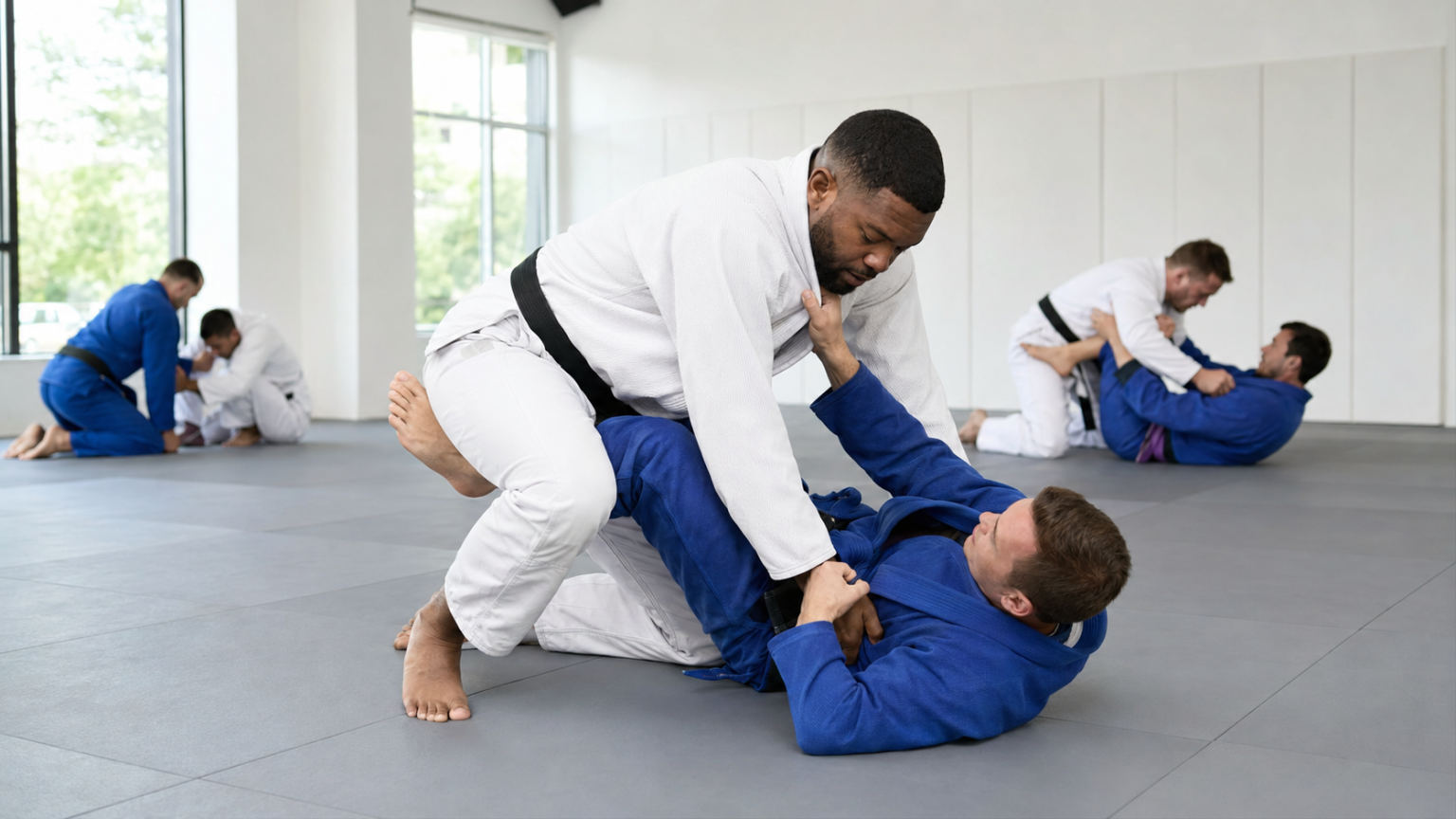
Brazilian Jiu Jitsu, commonly known as BJJ, is one of the most effective martial arts for learning how to protect yourself during a close-contact confrontation. It teaches practical ways to control an opponent, escape from dangerous positions and use leverage rather than relying entirely on strength.
BJJ is particularly valuable because many real-world confrontations involve grabbing, clinching or falling to the ground. Regular training helps you remain calmer under pressure and gives you practical experience of dealing with physical resistance.
However, no martial art can guarantee your safety in every situation. Brazilian Jiu Jitsu should be viewed as a highly useful set of self-defence skills alongside good awareness, sensible decision-making and avoiding confrontation whenever possible.
Why Brazilian Jiu Jitsu works for self-defence
One of the main principles of BJJ is that technique and leverage can help a smaller person control a larger or stronger opponent. Instead of relying on punching power, students learn how to use positioning, balance and body mechanics.
Training commonly includes:
- Escaping from underneath another person
- Controlling an opponent from a safer position
- Breaking or maintaining grips
- Protecting your head and body
- Using joint locks and choke holds
- Returning safely to your feet
These skills can be particularly useful if someone grabs you, pushes you to the ground or tries to hold you down.
Students attending our Brazilian Jiu Jitsu classes in Essex learn these techniques progressively in a controlled and supportive training environment.
Learning to respond against resistance
A major strength of Brazilian Jiu Jitsu is that techniques can be practised against a training partner who is actively resisting.
This is usually done through controlled sparring, often called rolling. Your training partner may try to escape, improve their position or control you while following clear safety rules. This gives you experience of applying techniques against realistic movement and pressure.
There is an important difference between understanding a technique and being able to use it while another person is resisting. Regular BJJ training helps to close that gap.
Over time, students become more comfortable making decisions when they are tired or under physical pressure. This can improve composure and reduce the likelihood of panicking during a threatening situation.
What if a confrontation goes to the ground?
Remaining on your feet and moving away is usually the safest option during a confrontation. Unfortunately, you may not always have that choice.
Someone could grab you, tackle you or knock you over. You might also trip while trying to move away. If this happens, Brazilian Jiu Jitsu gives you a better understanding of how to protect yourself and escape.
BJJ teaches students how to manage distance, create space and avoid becoming trapped beneath another person. The aim in self-defence is not necessarily to submit the other person. It may be to control them temporarily, escape from a dangerous position and stand up safely.
This distinction is important. Competition BJJ and self-defence training can use many of the same techniques, but their objectives are different. In a sporting match, the aim may be to score points or secure a submission. During a real confrontation, your priority should be to protect yourself and leave the situation.
Can a smaller person use BJJ effectively?
Brazilian Jiu Jitsu was developed around the idea that leverage, positioning and timing can help overcome differences in strength and size.
This does not mean that size and strength become irrelevant. A much larger person will still have physical advantages. However, a trained smaller person is likely to have more options than someone with no experience of grappling or ground defence.
Rather than trying to overpower an attacker, BJJ teaches you to use frames, angles and movement to create space. As your technique improves, you learn to conserve energy and avoid relying on strength alone.
This makes BJJ suitable for adults with different body types and fitness levels. You do not need to be exceptionally strong or athletic before beginning. Our Jiu Jitsu classes for Brentwood, Romford and Hornchurch welcome complete beginners as well as experienced students.
Does BJJ help with confidence?
The benefits of training are not limited to physical techniques. Brazilian Jiu Jitsu can also improve confidence, awareness and the ability to remain composed.
Knowing that you have practised difficult positions against resisting partners can make physical confrontation feel less unfamiliar. This does not encourage aggression. In many cases, greater confidence makes it easier to stay calm, avoid escalation and walk away.
Training also teaches patience and problem-solving. If a technique does not work, students learn to adjust their position rather than panic or use uncontrolled force.
What are the limitations of BJJ for self-defence?
Although Brazilian Jiu Jitsu is highly effective at close range, it has limitations.
Going to the ground can be dangerous if there is more than one attacker, particularly if you cannot see what is happening around you. Weapons and hard surfaces also make any physical confrontation more unpredictable.
BJJ training should never create the impression that every situation can be controlled. The safest response may be to move away, call for help or hand over property rather than fight.
Good self-defence begins before physical contact. Awareness, distance and avoiding unnecessary confrontation remain extremely important. If physical contact cannot be avoided, BJJ provides practical skills that can improve your ability to protect yourself, create an opportunity to escape and return to your feet.
Is Brazilian Jiu Jitsu suitable for beginners?
Yes. Brazilian Jiu Jitsu can be learnt by complete beginners, including people who have never studied a martial art before.
Early classes usually focus on basic positions, movement and safety. You will learn how to fall more safely, move on the ground, protect yourself and escape from common positions before progressing to more advanced techniques.
At the Jon Hegan Academy, students learn authentic Royce Gracie Jiu Jitsu under experienced instruction. Training is structured so that beginners can develop their skills at a manageable pace.
So, is BJJ effective for self-defence?
Brazilian Jiu Jitsu is an excellent martial art for self-defence, particularly when someone grabs you or a confrontation reaches the ground. It teaches practical techniques, exposes you to controlled resistance and helps you develop confidence under pressure.
It cannot remove every danger or replace good judgement. No martial art can make a person invincible. However, consistent BJJ training can give you valuable skills and a much better understanding of how to respond during a close-contact confrontation.
If you would like to experience the training for yourself, you can book a trial Brazilian Jiu Jitsu class at the Jon Hegan Academy in Upminster.