
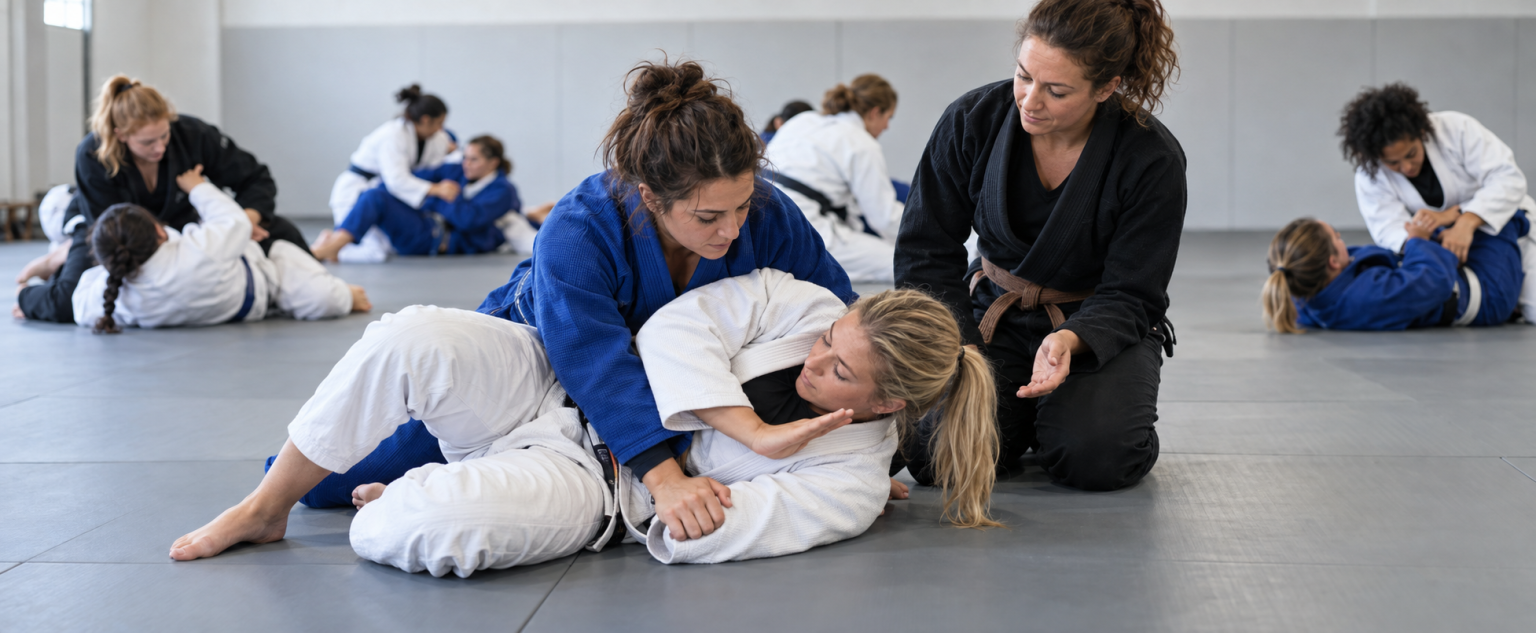
Brazilian Jiu Jitsu is attracting growing interest from women who want to improve their fitness, learn practical self-defence skills and take part in a challenging activity with clear opportunities for progression.
Once viewed mainly as a male-dominated combat sport, BJJ is becoming increasingly accessible to women of different ages, fitness levels and backgrounds. High-profile female competitors have helped increase its visibility, but most women who attend classes are not preparing for competitions. They are ordinary adults looking for an engaging way to exercise, build confidence and learn something useful.
You do not need previous martial arts experience or exceptional strength to begin. Brazilian Jiu Jitsu is based on technique, leverage, positioning and timing, making it suitable for women who want to develop skills progressively within a controlled training environment.
Why is Brazilian Jiu Jitsu becoming more popular with women?
One reason is that BJJ provides more than a conventional workout. A class combines physical exercise with learning techniques, solving problems and working with training partners.
Rather than repeating the same gym routine, students continually encounter new positions and movements. Each class provides an opportunity to learn, practise and gradually improve.
Women are also becoming more visible throughout the sport. Successful female competitors, coaches and recreational students are helping to show that Brazilian Jiu Jitsu is not exclusively for young men or professional fighters.
The growing community surrounding BJJ also plays an important role. A supportive academy can provide a welcoming environment where women train alongside people with different levels of experience while working towards their own personal goals.
Can Brazilian Jiu Jitsu help women learn self-defence?
Brazilian Jiu Jitsu can provide valuable close-contact self-defence skills. It teaches students how to maintain their balance, manage distance, escape from difficult positions and control another person using positioning and leverage.
This can be particularly relevant when someone is grabbed, held or forced to the ground. Students practise dealing with physical resistance in a controlled setting, helping them become more familiar with pressure and close contact.
Size and strength still matter in any physical confrontation. BJJ does not make those differences disappear, and no martial art can guarantee someone’s safety. However, learning effective techniques can give a smaller person more options than they would have without training.
Self-defence also begins before physical contact. Awareness, recognising potential danger, maintaining distance and leaving a threatening situation remain extremely important. BJJ should be considered part of a wider approach to personal safety rather than a reason to take unnecessary risks.
You can read more about whether Brazilian Jiu Jitsu is effective for self-defence.
Does BJJ rely on strength?
Brazilian Jiu Jitsu is designed around using technique efficiently rather than attempting to overpower every opponent.
Students learn how angles, frames, balance and body positioning can help them create space or improve their position. This makes BJJ appealing to women who may initially worry about training with someone who is physically stronger.
Strength can still be an advantage, but good technique helps students use their energy more effectively. As beginners progress, they learn when to apply pressure, when to move and when to remain calm.
This technical element also makes BJJ mentally engaging. A technique may need to be adjusted depending on a training partner’s size, position and reaction. The process is often compared to solving a physical puzzle.
Is Brazilian Jiu Jitsu a good workout for women?
BJJ provides a varied full-body workout that can help improve cardiovascular fitness, muscular endurance, balance, mobility and coordination.
A typical class may include movement exercises, technical demonstrations, partner drills and controlled sparring as students progress. The intensity varies depending on the activity and the individual’s level of experience.
Regular training can help develop:
- Core strength and stability
- Cardiovascular fitness
- Balance and body awareness
- Mobility and flexibility
- Muscular endurance
- Grip strength
You do not need to become fit before attending your first class. Beginners arrive with different fitness levels, and physical conditioning develops gradually through regular training.
For anyone who finds conventional exercise repetitive, BJJ can make fitness more engaging because the focus is on learning and applying techniques rather than simply completing a set number of repetitions. Our guide compares Brazilian Jiu Jitsu with a conventional gym workout.
Can BJJ improve confidence?
Confidence in Brazilian Jiu Jitsu usually develops through experience rather than being expected from the beginning.
Learning how to escape from a difficult position, completing a challenging class or successfully applying a technique can provide a genuine sense of achievement. Progress may initially appear gradual, but small improvements build over time.
Training with controlled resistance can also help students become more composed under pressure. They learn to breathe, think and make decisions while dealing with another person’s movement.
This does not mean BJJ encourages aggression. Greater confidence can make it easier to remain calm, recognise personal boundaries and avoid panic when faced with a difficult situation.
What if you feel nervous about close-contact training?
It is completely understandable to feel uncertain about the close-contact nature of Brazilian Jiu Jitsu. Many beginners, both women and men, feel nervous before attending their first class.
A professional academy should explain how partner work is managed and introduce techniques progressively. You should never be expected to understand everything immediately or take part in training beyond your current ability.
Communication is an important part of BJJ. Students can ask questions, tell a partner if they are uncomfortable and stop a technique by tapping. The tap system allows someone to signal immediately that a position or submission should be released.
At Jon Hegan Academy, the same core Gracie Jiu Jitsu techniques are taught to men and women, with minor adjustments where appropriate. The academy’s frequently asked questions provide more information about safety and how classes are structured.
Do women have to train with men?
Many Brazilian Jiu Jitsu academies run mixed classes, particularly at adult beginner level. Training partners may be selected according to size, experience and the technique being practised.
Training with different partners can be beneficial because each person moves and reacts differently. However, students should always feel able to discuss any concerns with their instructor.
A good instructor will understand that a new student may prefer to begin gradually. Nobody should feel pressured into training with a particular partner or at an intensity that makes them uncomfortable.
Respect, communication and control are essential. The purpose of partner training is to help both people learn, not for one student to dominate or intimidate the other.
What should women wear to their first BJJ class?
You do not necessarily need to buy specialist clothing before attending a trial session. The academy can confirm whether a gi is required and what it can provide for beginners.
Depending on the class, suitable clothing may include:
- A fitted T-shirt or rash guard
- Sports leggings or athletic trousers
- Sports shorts without pockets or zips
- A properly fitted BJJ gi when required
Avoid jewellery, metal zips and loose items that could become caught during training. Long hair should be tied back, and fingernails and toenails should be kept short.
Our complete guide explains what to wear to your first Brazilian Jiu Jitsu class.
Is Brazilian Jiu Jitsu suitable for women starting later in life?
Women can begin Brazilian Jiu Jitsu in their 30s, 40s, 50s or later. There is no requirement to have started martial arts as a child.
Older beginners may choose to manage their training intensity carefully and allow sufficient time for recovery. Starting with one or two classes each week can help the body adjust gradually.
The goal does not have to be competition. Many women train for fitness, confidence, self-defence, stress relief and personal development.
Age, previous experience and current fitness will influence how someone approaches training, but they do not automatically prevent participation. Read more about starting Brazilian Jiu Jitsu later in life.
Frequently asked questions
Is Brazilian Jiu Jitsu safe for women?
BJJ can be practised safely when techniques are taught progressively and students train with control. Following instructions, communicating with training partners and tapping early are important parts of reducing risk.
Do women need to be strong to start BJJ?
No. Strength can be helpful, but beginners are taught to use positioning, leverage and technique. Fitness and physical confidence develop through regular training.
Can women train Brazilian Jiu Jitsu for self-defence?
Yes. BJJ teaches practical skills for escaping, controlling and managing close-contact situations. It should be combined with awareness, avoidance and sensible decision-making.
Is BJJ suitable for complete beginners?
Yes. Beginner classes introduce fundamental movements, positions and safety principles before progressing to more advanced techniques.
Do women have to compete?
No. Competition is optional. Many women train solely for fitness, confidence, self-defence, enjoyment and the social side of attending an academy.
Where can women learn Brazilian Jiu Jitsu in Essex?
Jon Hegan Academy offers authentic Brazilian Jiu Jitsu classes in Essex at its Upminster training venue. The academy welcomes adult beginners travelling from Hornchurch, Romford, Brentwood and surrounding areas.
Start Brazilian Jiu Jitsu at Jon Hegan Academy
Brazilian Jiu Jitsu gives women an opportunity to improve their fitness, learn practical techniques and become more confident within a structured training environment.
Jon Hegan Academy is a Royce Gracie Jiu Jitsu affiliate, providing authentic Gracie Jiu Jitsu instruction for complete beginners and experienced students.
If you are interested but unsure whether BJJ is right for you, a trial session is the best way to experience the training, meet the instructors and see the academy environment for yourself.
Book your trial Brazilian Jiu Jitsu classes at Jon Hegan Academy in Upminster.